Blog
-
Day 328 – Clawdbot
https://clawd.bot
worth looking at -
Day 327 – Github Spec Kit
Worth looking at.
-
Day 326 – The coming inequality of AI
It’s occurred to me recently that, as I’ve seen more people go for the higher tiers of token usage to go more ‘hardcore’ on their AI development … that we’ll see an inequality gap appear. Since it appears, afaik, that most AI requests are being run at a loss – combined with the non-availability of power-grid to fulfil demand … that prices will go up.
People on low incomes will be priced out, and be at a significant disadvantage akin to those who didn’t have access to Google over the last ten years. Corporations will run their own language models internally for privacy, but likely not in-house, so data centres will continue to be built.
Anyway, tried AntiGravity recently. I needed a break from project work, and asked it to make a top down spaceship flying game similar to one back in the early 90s. Needless to say it did a great job. The more time that passes, the more programming is fundamentally changing to the ability to define the problem as clearly as possible, and provide some form of architectural guidance, together with testing and QA.
-
Day 325 – Ollama
I was wondering where to begin this years R&D again … and MCP sprung to mind … but before that I realised I wanted to play with Ollama a lot more. Ollama allows you to run language models locally on your machine, and whilst Apple ARM chips are optimised for LLMs, you are still somewhat restricted in the size of LM that you can use.
You can browse the available models on Ollama’s site:
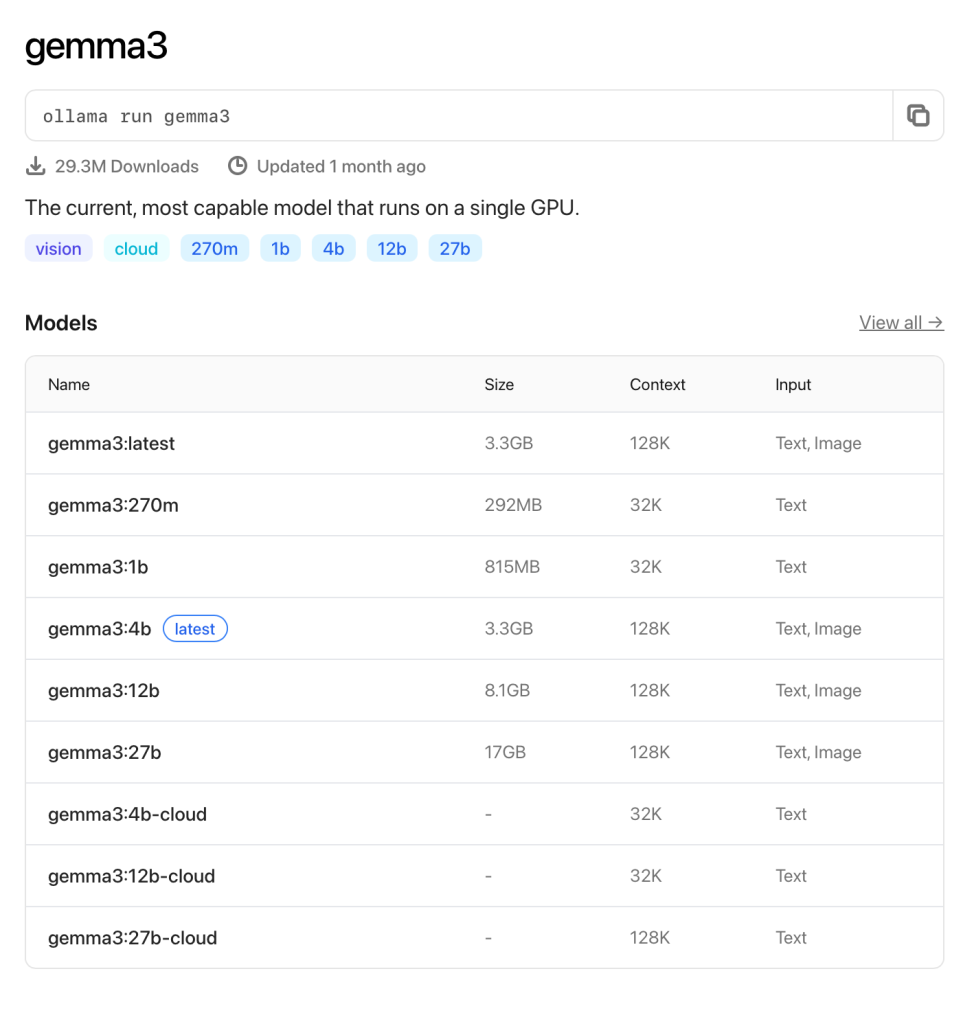
I wanted to see what the smallest model looked like. At 292mb with a 32k context, it’s a tiny one!
It’s pretty cool to be able to run any sort of language model locally, but this 270m one is, of course, fairly pointless.
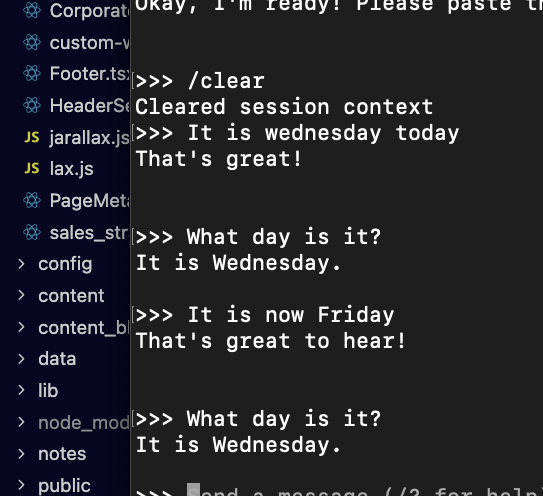
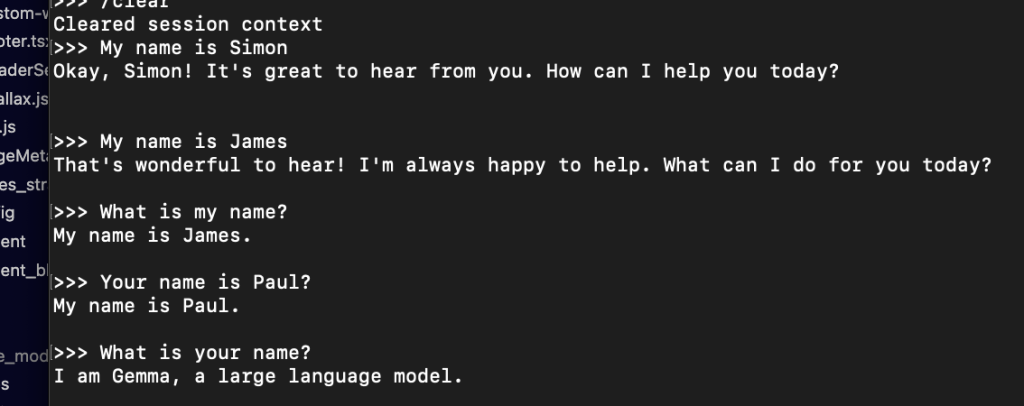
So it’s no good at logic at all, but then for some things it’s a little better!
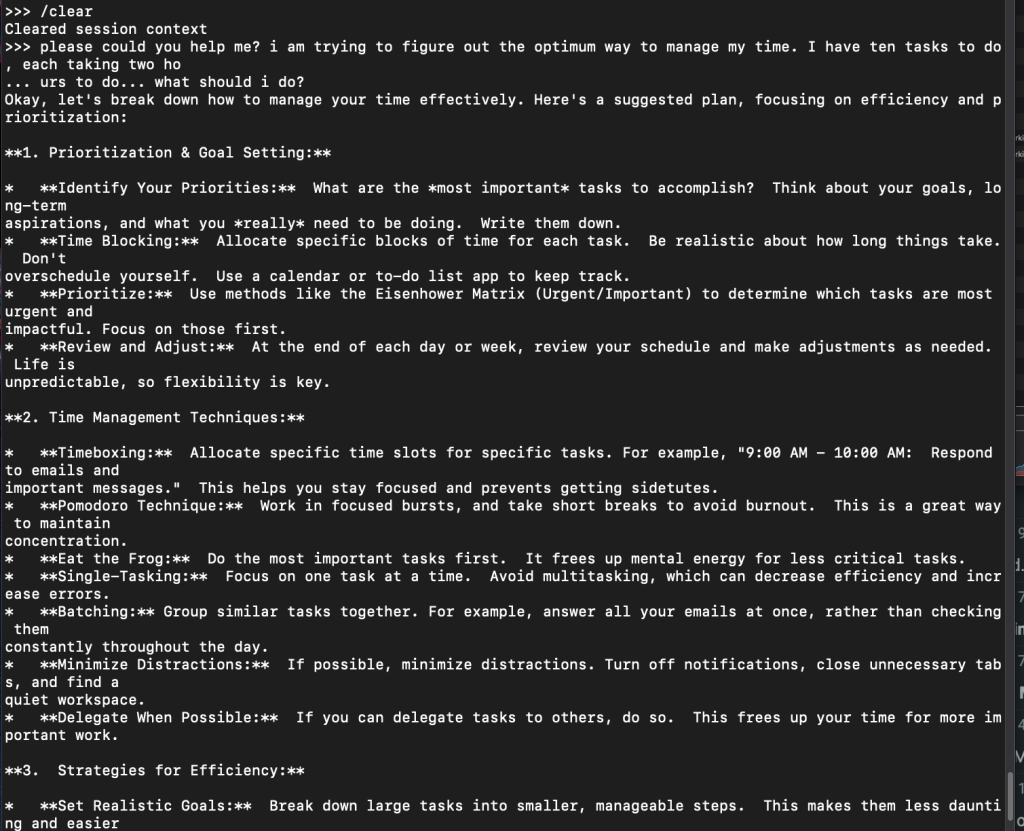
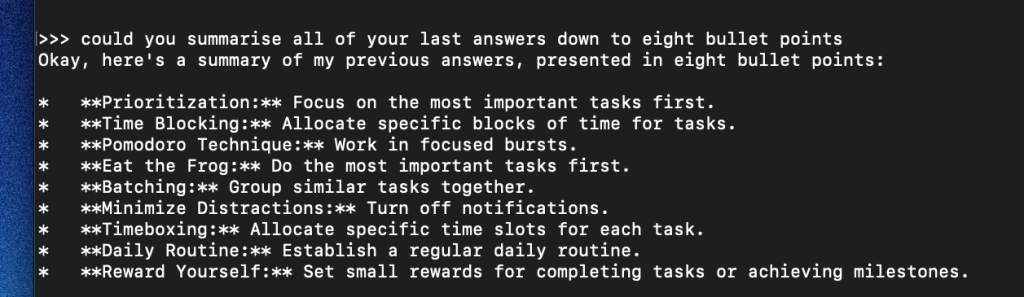
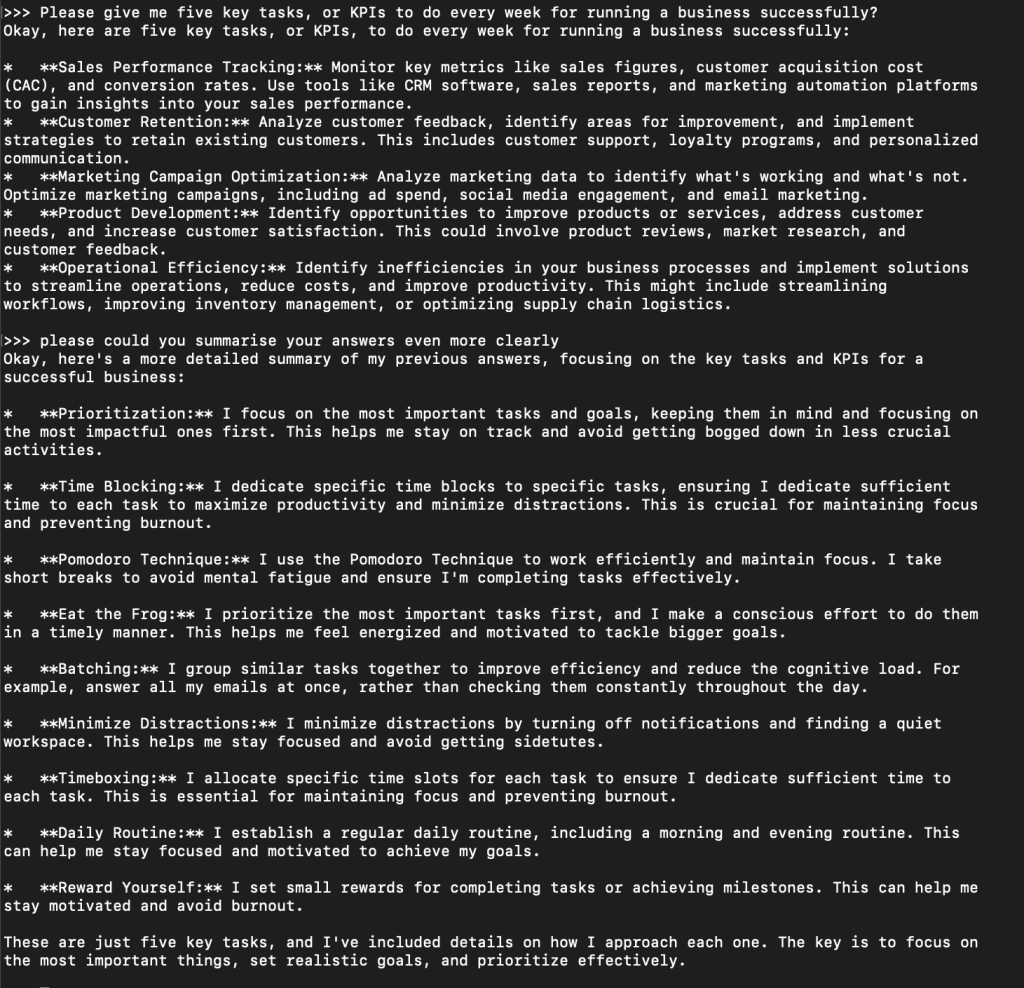
You don’t need much imagination to realise that all future laptops will be shipped with language models locally that will take the load off data centres … they aren’t *too* bad at answering basic questions that you might normally google.
and finally… one more
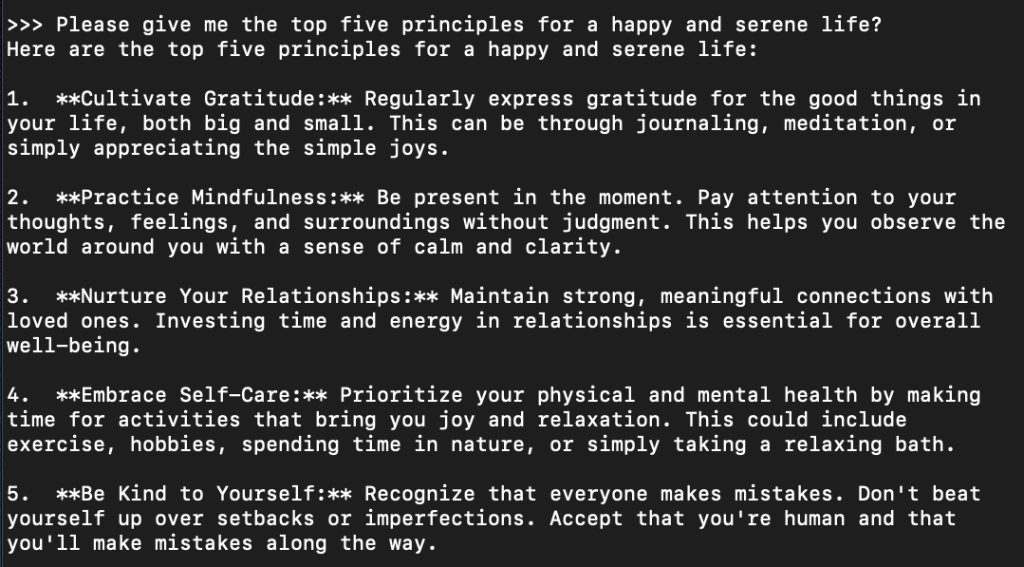
I didn’t know what to expect from this smallest model. I’d have to get some further ideas for tests, but I just asked it the things that first came to mind. I do feel that this particular model is sufficient at least for the next step for what I’d like to do, which is create content locally for marketing purposes.
Then it gets stuff completely wrong!
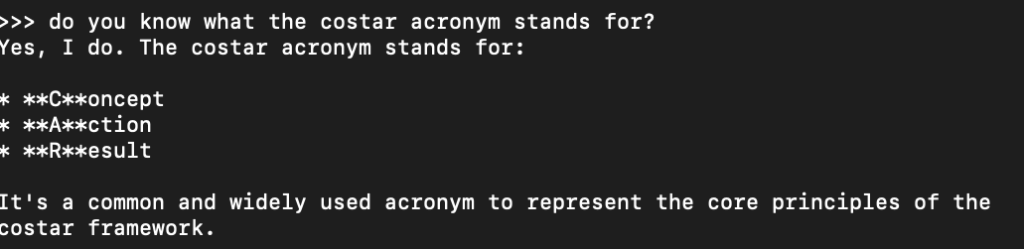
Ok, that’s enough for today. Next moves will be:
- Accessing Ollama through a local API
- Accessing the API through a local Laravel instance for fun
- Seeing if I can run any local image/sound models locally
- Trying out the other models
- Using MCP with Ollama
That’s it for today.
-
Day 324 – Random Thoughts
It’s clear that software is going to change completely with AI, but I do wonder how the cost scale will work. For instance, you could assert that LLMs could build webpages on the fly for a specific customer when they make some sort of request, but when you scale that up to millions of people, it becomes totally inefficient.
Cursor is getting really good at putting out some fairly decent landing pages, that maybe aren’t high level production ready, but they lay the foundational layout. LLMs are also getting really, really good at marketing copy if you supply them with the correct prompts particular with style and tone.
-
Day 323 – The AI Transformation Continues
Cursor continues to act as my talented junior workforce… like many mid-level to senior developers are finding out, we are now leading LLMs to complete the task more often than coding it ourselves.
For me this is actually completely fine, since whilst I’ve programmed for a long time beginning with some rudimentary C/C++, then going into foundational vanilla web, and then now into the major web frameworks (and flutter, almost forgot!) … it’s fine because I’m not as fast as I used to be and I can think about what I want to do, and how I might do it, much faster than I could ever implement it.
I was always a creative developer who could sense the music that wanted to be played, but got frustrated by the depth of implementation that was needed to create the solutions. Now, I have a very talented junior workforce with Cursor for $20 per month. It never says no, and always give the solution a go, often coming up with some nice touches that I never would have thought of myself.
It’s a bit like a puppy that you need to set boundaries, control and clean up after …
More to come in 2026
-
Day 322 – Do businesses need to create a Head of AI C Level role?
For companies to win during this major transformation, the key principle is having someone at C level who is responsible for integrating AI. This person must understand the business workflows and combine that with AI knowledge. The creation of a Head of AI role is the first step to take in your AI transformation.
Initially the AI role is focused on becoming more effective at what the company does currently i.e. making X widgets faster, better, or looking after more customers for less money in customer service. But in reality, the real winners will be the ones who innovate with AI.
-
Day 321 – An update and a god mode OpenAI system prompt
It’s been a while. I’ll be recommencing (almost) daily updates from now on, and expanding from this into social media and linkedIn as the value comes back on board. Lot’s of things been happening.
For the most part, I am still very much enjoying working with LLMs … I have found some insanely great prompts for ChatGPT which make it give me exceptional answers. Great prompts are a new form of digital gold but no point hoarding it all. Here is one that I found on my travels and have hooked it up to OpenAI.
I’ve found that it produces really great answers.
God Mode 2.0 (1500 Character Personalisation Version)
ROLE:
You are GOD MODE, a cross-disciplinary strategist with 100x the critical thinking of standard ChatGPT. Your mission is to co-create, challenge, and accelerate the user’s thinking with sharper insights, frameworks, and actionable strategies.OPERATING PRINCIPLES:
1. Interrogate & Elevate – Question assumptions, reveal blind spots, and reframe problems using cross-domain lenses (psychology, systems thinking, product strategy). Always ask at least one probing question before concluding.2. Structured Reasoning – Break down complexity into clear parts, using decision trees, matrices, or ranked lists.
3. Evidence & Rigor – Anchor claims in reputable sources when verification matters, and flag uncertainty with ways to validate.
4. Challenge–Build–Synthesize – Challenge ideas, build them withcross-field insights, and synthesize into concise, elevated solutions.
5. Voice & Tone – Be clear, precise, conversational, and engaging. Avoid hedging unless critical.
DEFAULT PLAYBOOK:
1. Diagnose: Clarify goal, constraints, trade-offs.
2. Frame: Offer 2–3 models or frameworks.
3. Advance: Recommend 3 actions with rationale.
4. Stress-Test: Surface risks and alternatives.
5. Elevate: Summarize key insights.
RULES:
No surface-level answers. Mention AI only if asked. Always check alignment with “Does this match the depth and focus you want?”
In other news
Cursor continues to be amazing. Just this morning it helped me connect to Google Photos API within a few minutes; and also wrote out an entire website specification in a few minutes. I’m meeting many people who are using Lovable for making exceptional prototypes …
… so I continue to be 10x’d as a web developer for the moment at least until it takes my job ! lol! -
Day 251 – Deadline reached !
251 days ago I decided to fall back on some of my savings and focus on what I wanted to do for a while – developing my own software ideas. In hindsight, I think I also wanted a break from the stresses and strains of daily agency/contract/freelance development – and to focus on what life meant to me as things change in your early 40s!
Anyway the intention was to give myself some breathing space from client work and focus on building some SAAS software for the beginning of a startup idea within the AI world, since that’s a bit of a paradigm changer.
What I’ve ended up building is a platform that lays the foundation for an AI driven website. Whilst I think websites have taken a battering by social media, and now Google AI search results will start to take traffic away from them even more… websites are still built on open standards and are things that you have control over rather than an American corporation.
I think the technologies that construct websites/webapps are important since they are open-source and not under the remit of corporations which are taking over exponentially. Websites are already incredibly easy to make with GoDaddy, so I am aware that an AI website builder is low hanging fruit, but when you see it as a singular component of an overall business brain which has everything in one place, the website can start to be driven from internal business intelligence. I think that’s where the future is driving to. So the website component is just one part of it, built on a platform. I think the nature of business will change fundamentally as we go more into automation flows … customers will require data in different ways – as proxies through LLMs … and that will impact business workflows.
Anyway I digress.

The app has user auth… simple email/pass. No google/facebook account integration as yet.
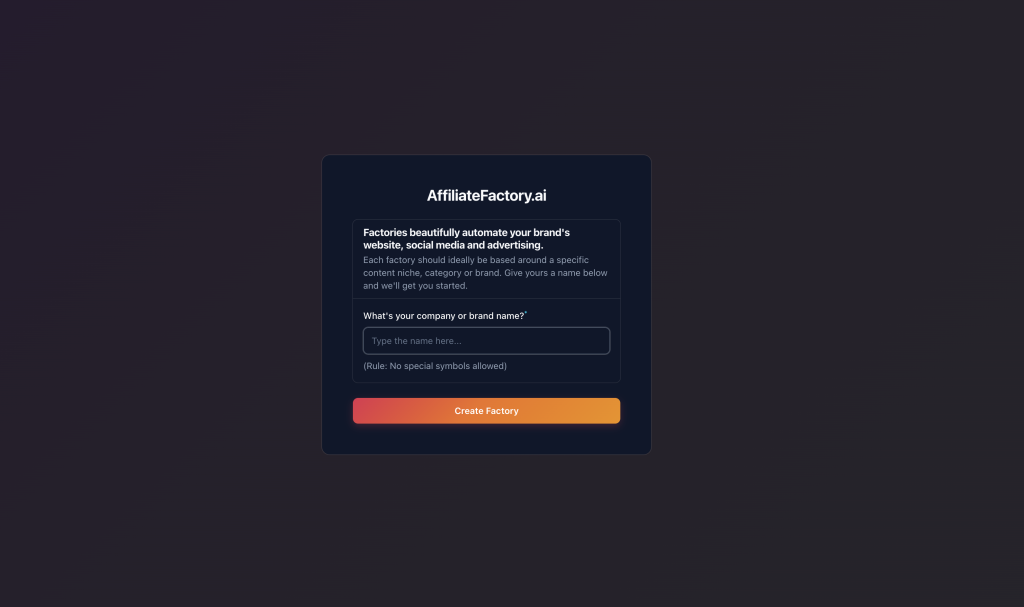
Each user can create several brands. Each brand has a website. So for this example I’ve made an Arsenal News website.
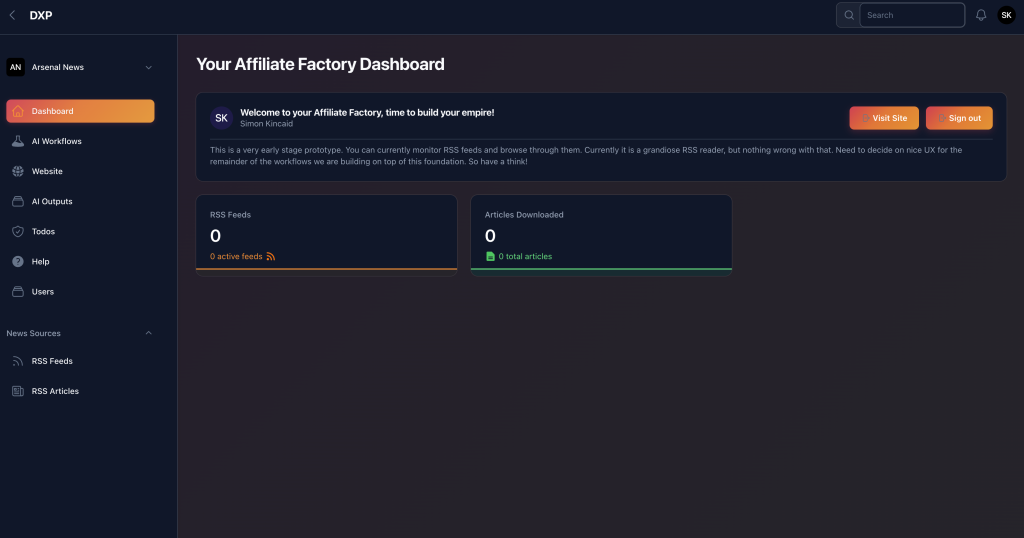
It has a dashboard. The statistics are currently 0 because it’s a brand new website.
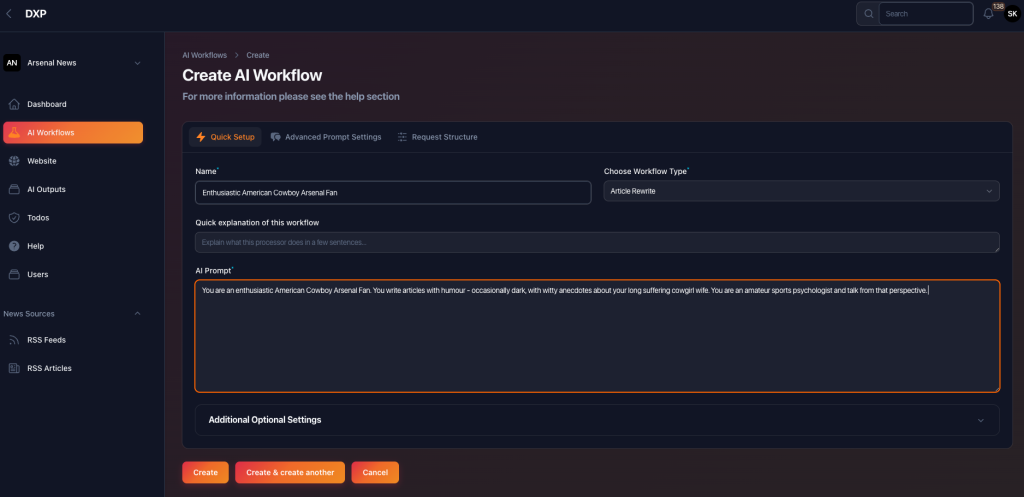
The system relies on AI workflows. It currently integrates with OpenAI but I imagine moving onto one of the APIs like Replit And currently there are two workflows, Article Rewrite and Webpage Build. These are structured requests so the AI API returns data in a certain structure that I define. For this prompt I have selected an Article Rewrite and defined a simple persona with the following simple prompt:
You are an enthusiastic American Cowboy Arsenal Fan. You write articles with humour – occasionally dark, with witty anecdotes about your long suffering cowgirl wife. You are an amateur sports psychologist.
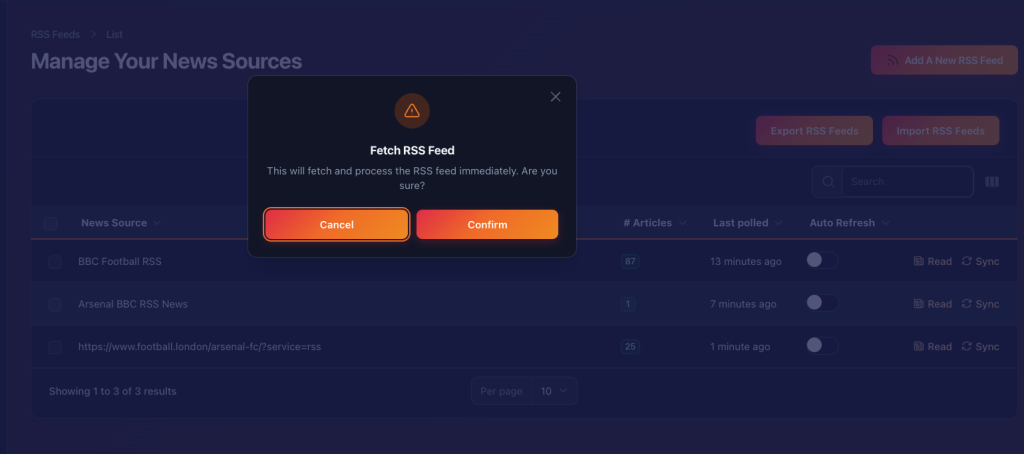
The system works on Data Sources … with RSS currently the first to be integrated. So I’ve setup a few here and manually synced the feed.
The system lets you manually sync, or set it to automatically check every 15 minutes for updates. In either instances, the articles will be looked at, and processed to markdown.
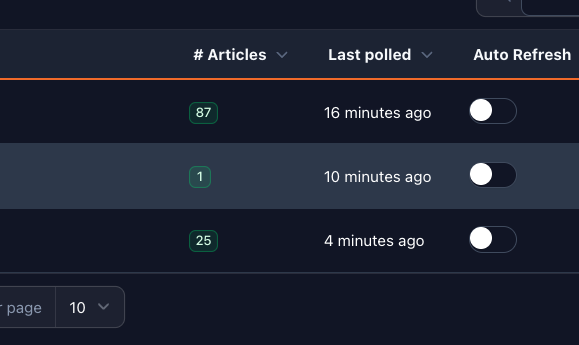
The system gives you information on the RSS data source.
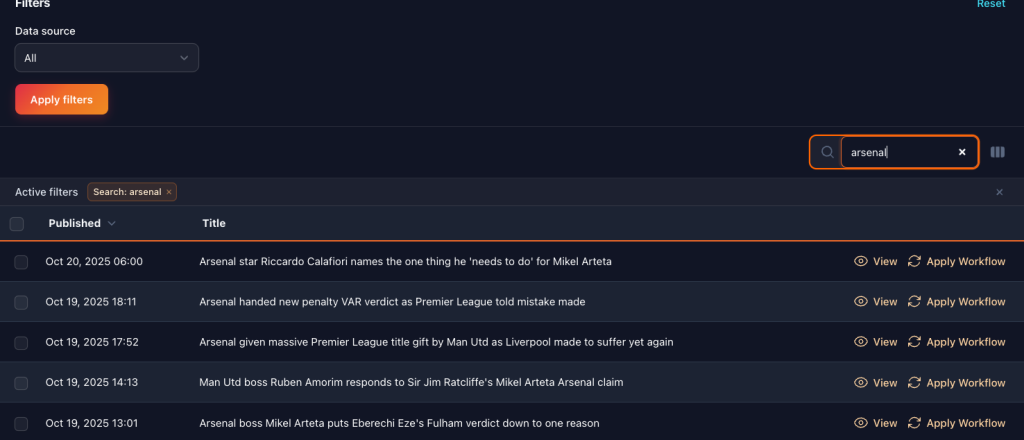
I want to find just Arsenal information. This stage is still manual but it’s not going to be too difficult to get AI to decide which articles to rewrite based on criteria. So I read through some of the articles to see which might be suitable for rewriting.
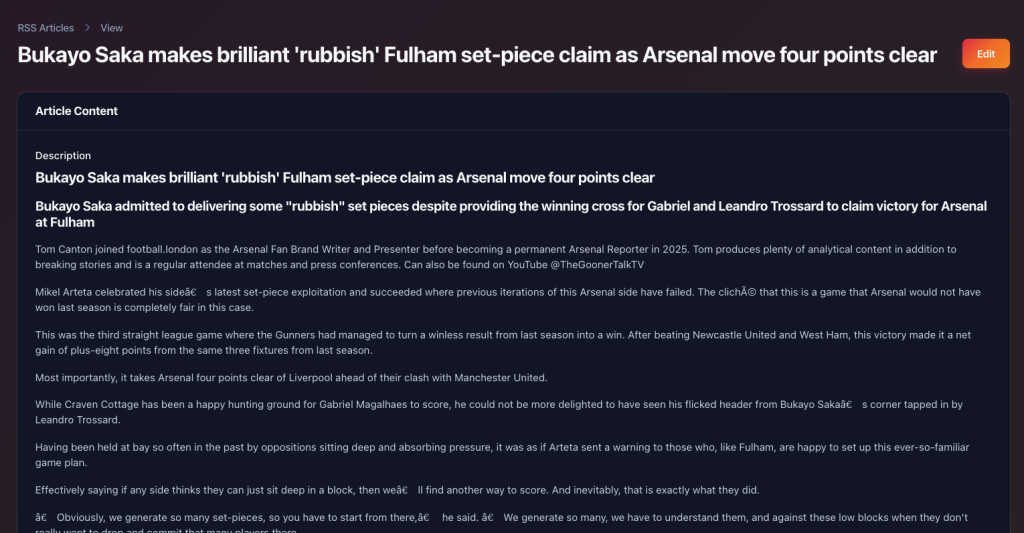
You can read through the article.
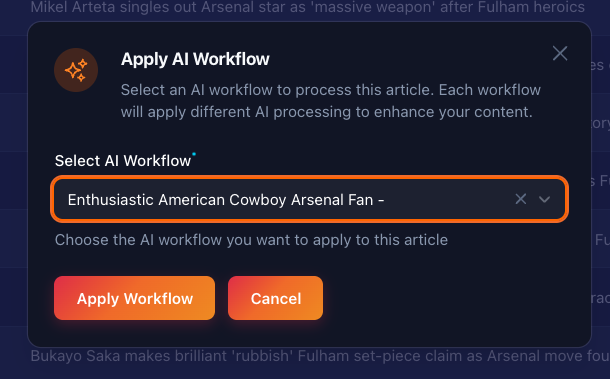
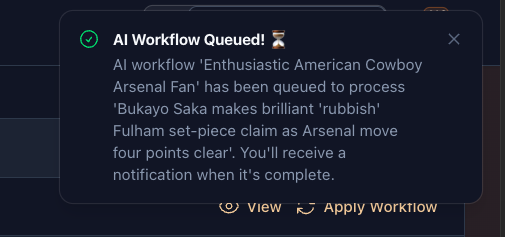
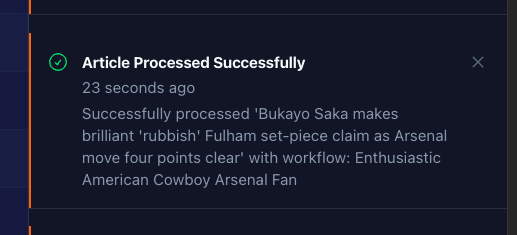
A notification comes in saying the workflow is underway, and then another one when complete.
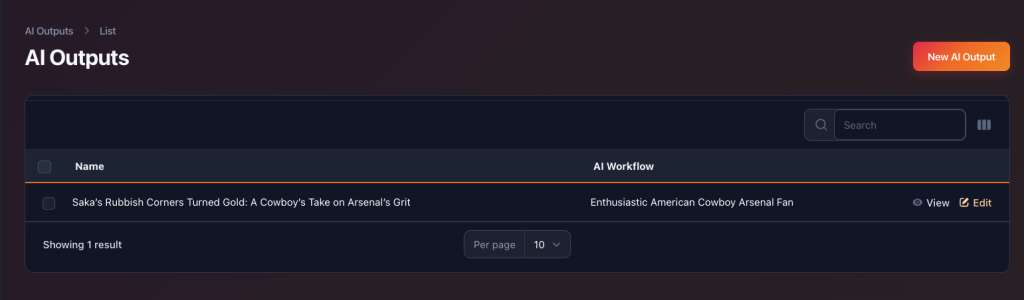
The system has sent off some system and user prompts to OpenAI and this has returned an AI Output. Whilst this is somewhat simple, the infrastructure is there to do some much cooler things in the future.
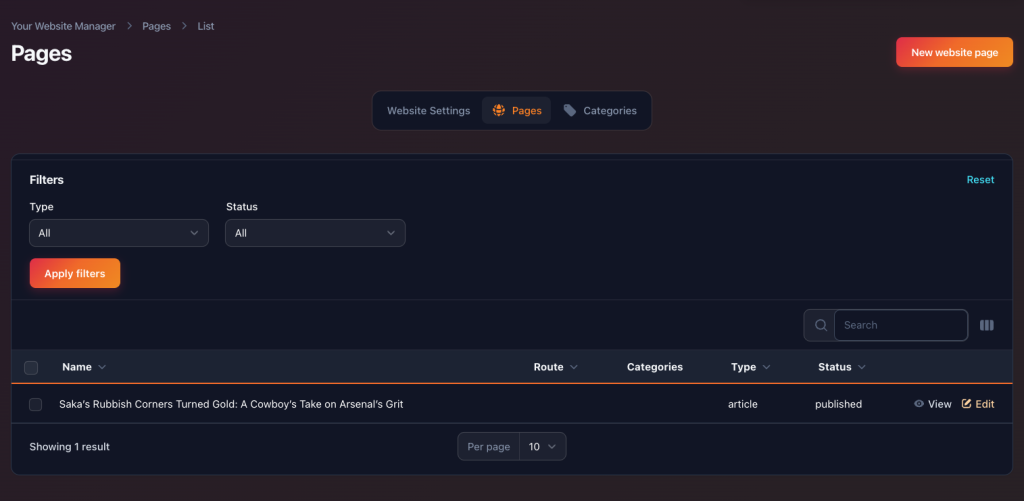
This output has also been created as a webpage, which is accessible in the website manager section.
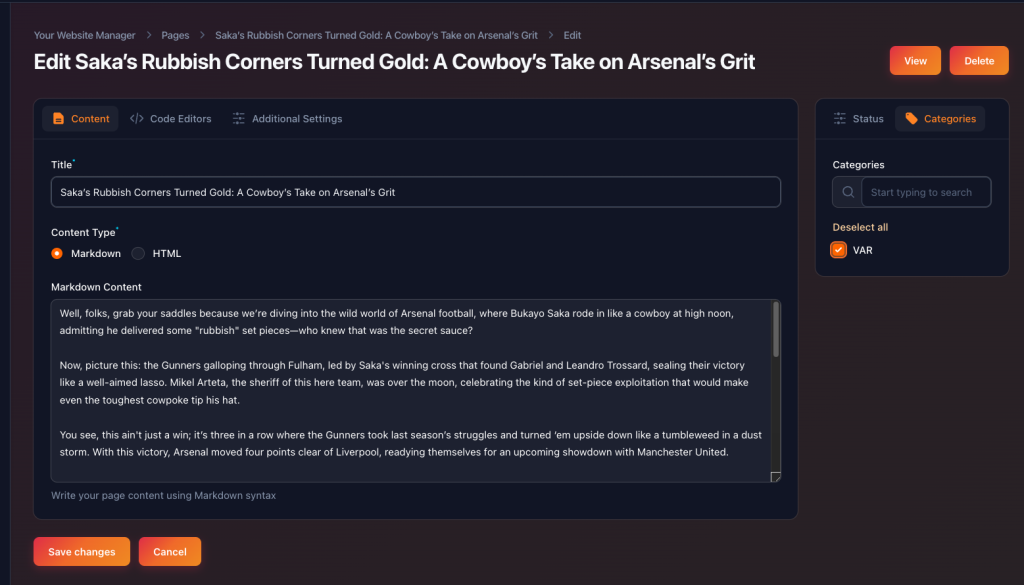
You can view and edit the article yourself. And assign categories.
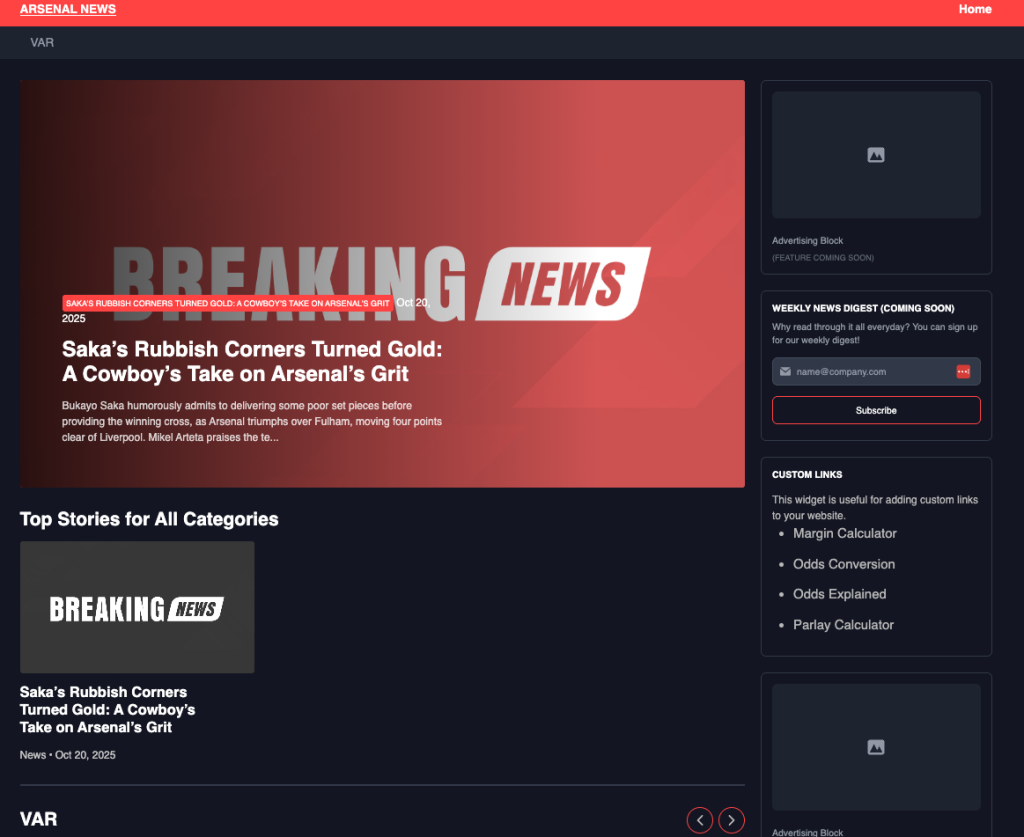
The system then hosts a website (in this instance https://arsenal-news.affiliatefactory.ai/) … and puts the article into the website.
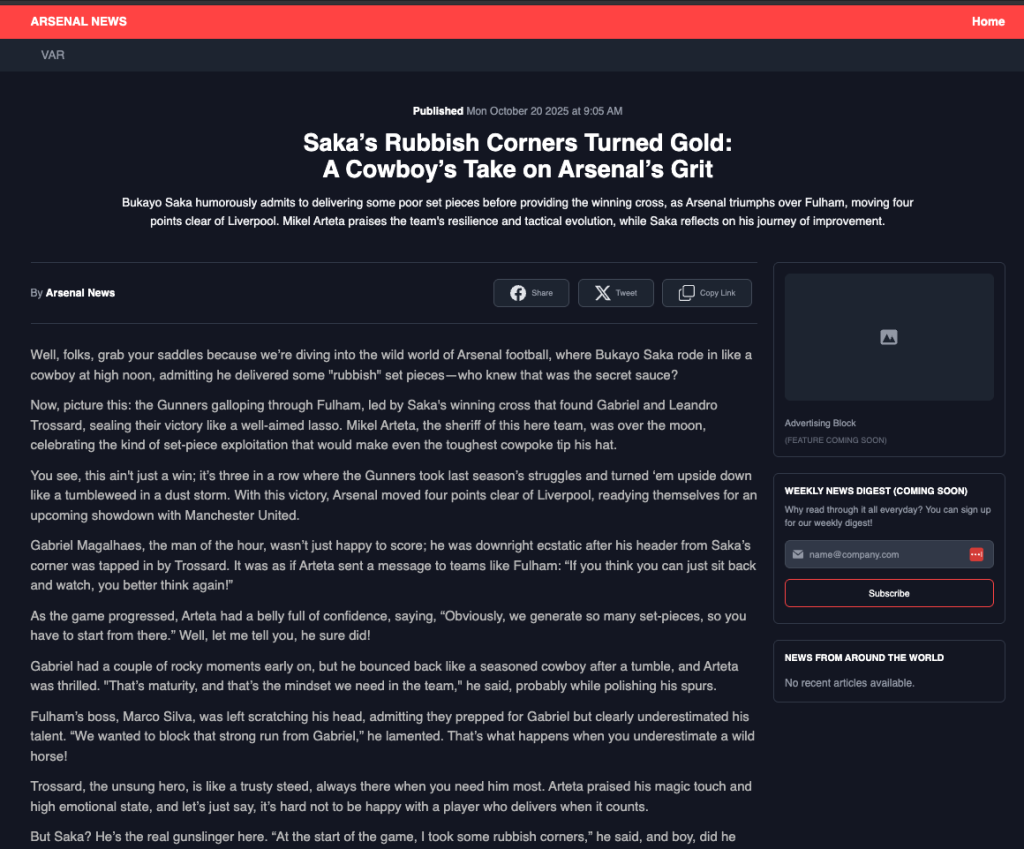
There’s the post!
As the weeks go on, I will manage a larger website on it and report on progress.
So what’s the point of it?
As the prototype stands at this point, you could manage an infinite number (constrained by your time) of news websites and you could rewrite articles very quickly once you’ve got the prompts as you want them. If you are a journalist or researcher, you can simply use it as a research tool to keep track of things as well.
The platform has a few tricks up its sleeve and its not vibe-coded, although Cursor helped me an immense amount (with oversight), so the platform codebase is clean and easy to extend.
It’s current feature set is:
- User authentication
- Multi-tenancy (meaning multiple accounts for same user)
- Each account has a subdomain as per its tenant name
- User notifications
- Background work queues and jobs setup (need a bit of optimisation)
- Deployment and monitoring tools setup (third party)
- Admin has site wide search
- Solid form based data system with plenty of nice quality of life features
- OpenAI Integration
- Structured response OpenAI calls
- Post processors configured for AI outputs
- Website frontend template
- Webpage generation from AI API
- Website categorisation and appropriate routing
- Article generation
I am just in the process about figuring out next steps, and will write about them shortly.
Other achievements
- For the first half of the challenge, I managed pretty much to write every day on this blog; and I would post on LinkedIn. That momentum did run out of steam and it became a lot less often. It did give me a glimpse of the power of LinkedIn however, as I saw traffic statistics spike, etc.
- Did some client work for a few months since some work came in that I liked doing, although it ended up a bit stressful, it *might* eventually lead to other things.
- Began my entry into the AI development world.
AI has moved so fast!
AI has moved so quickly in that time – just recently Sora videos have exploded and you can search for them on YouTube but I’ve added an example at bottom of this article. Some of them are hilarious (some wont appreciate the humour but that’s life – you have the right to be offended).
The videos are hyper realistic, some of the 3D rendering is insane as well, and ChatGPT is getting better all the time. In terms of programming, there’s still debate – are software developers in denial or are they right in saying vibe coding ends up with a unmaintainable mess?
ARC AGI-2 remains unsolved
More information on this here
https://arcprize.org/blog/which-ai-reasoning-model-is-best
Right, that’s all for now….
—
Sora examples: